Blog Feed
how to say your name
Letter pronunciation
A AH
B BEH
C SEH
D DAY
E A
F F-AY
G HEY
H ACHE
I E
J KOTA
K KA
L L-AY
M M-EH
N N-EH
ñ N-YAY
O O
P PEH
Q KOO
R EREH
S S-EH
T T-EH
U OOO
V BEH
W DOUBLE BEH
X A-KEYS
Y E-GRE-AGA
Z SETA
How to find the weather at your next vacation spot
How to find out the weather at your next vacation spot!
Here'a a video example of how you would ask and tell the weather.
Learn the Alphabet
Weather in Espanol
-Hot
-Cold
-Raining
-Snowing
-Cloudy
-Windy
Aprendiendo espaol con joshua
Learning how to say the days of the week in Spanish
-What day the week starts with
-How to say Monday, Tuesday, Wednesday, Etc
-How to say what day it is
Greetings and Good byes in Spanish
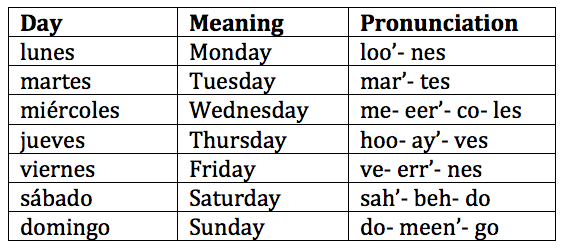
Days of the week!
Hola! Greetings:
In order to greet someone and have a simple conversation in Spanish you have to know:
How to say Hello in Spanish
How to Ask someone their name
How to ask someone how they are doing.
You can say hello to someone by saying one of the following greetings according to the time of day:
¡Hola! = Hello (Anytime)
¡Buenos dias!= Good Morning
¡Buenas Tardes!= Good Afternoon
¡Buenas noches!= Goodnight
When asking someone their name in Espanol you say ¿Como Te llama?
There are two ways to ask someone their name. When speaking to an adult to say ¿Come se llama?
When speaking to an peer you say ¿Como te llama?
If someone was to ask you ¿Como te llama?, meaning "What's your name", you would say in respone
"Me llama es ___(your name)"
Finally if someone ask you your name and you want to know what's theirs in return you say (if adult) ¿Como se llama (Usted)? or just ¿Y Usted?. When asking a peer what's their name in response you say ¿Como te llamo (tu)?, or just ¿Y tu?.
¿Y? Makes the E sound
When asking someone how they are doing you say:
¿Como estas?(peer)
¿Como esta?(adult)
¿Que tal?
Ways to tell someone how you are doing:
(Muy) Bein, gracias = (Very) Good thankyou
Mas o menos. = Regular/fine/okay/average
(Muy) Mal = (Very) Terrible
Just like the names, if someone ask you how you're doing and you want to know how they're doing in return you say:
¿Como estas(tu)? or just ¿Y tu? (peer).
When asking an adult you say ¿Como esta (usted)? or just ¿Y Usted?
Now here's a video of two people meeting for the first time greeting each other in Espanol
hola! come estas?: how to greet someone in spanish
First thing: how to say hello. This is very easy. If you want to say hi all you have to say is ¡Hola!. For example you can say ¡hola! Brenda and that means hello brenda.
Next, how to greet someone by saying good morning, good afternoon, and good evening in Spanish. This one is a little bite harder but is still easy. If you want to say good morning you say ¡buenos días!, if you want to say good afternoon you can say ¡buenas tardes!, and if you want to say good evening you would say ¡buenas noches!. For example u would say ¡Hola! ¡Buenos días! Branda.
Now if you don’t know someones name to ask them you would say ¿cómo te llamas or ¿cómo se llama. ¿cómo te llamas is informal and ¿cómo se llama is formal. If you want to ask a girl for her name you would say ¿cómo te llamas. But if you want to ask the president for his name you would say ¿cómo te llama. Or you can start the conversation by saying your name first. You can say me llamo ( your name) y tu? ¿y tu? Means and you. The you can say mucho gusto which means nice to meet you.
Greetings | Greetings |
¡Hola! | Hello! |
¡Buenos días! | Good morning |
¡buenas tardes! | Good afternoon |
¡buenas noches! | Good evening! |
Meeting someone | Meeting someone |
¿cómo te llamas? informal | What’s your name? |
¿cómo se llama? formal | What is your name? |
Me llamo _______________ | My name is _____________. |
¿Y tú? informal | And you? |
¿ Y ud? formal | And you? |
Mucho gusto | Nice to meet you. |
The Days Of The Week In Espaol
lunes- Monday
Asking About The Day | |
¿Qué día es hoy?/ Qué día es hoy no la escuela? | What’s the day?/ What day is there no school? |
Hoy es (lunes, martes, miércoles…) | Today is ________________________ |
Mañana es (lunes, martes, miércoles…)_ | |
In the Link below, it will teach you how to how to ask, "What's the day?" in Español.
How to spell your name
1.The letters:A B C D E F G H I J K L M N n` O P Q R S T U V W X Y Z
2.How to pronounce the letters: A=Ah B=Beh C=Seh D=Deh E=E F=Effeh G=Hey H=Acheh I=E J=Jota K=Kah L=Eleh M=Emeh N=Eneh N~=Enyeh O= Oh P=Peh Q=Que R=Ereh S=Eseh T=Teh U=Oooh V=Beh W=Doble-Beh X=Equis Y=Igreiga Z=Seta
Learn the Weather
Gracias, con perdn, Por favor (Thanks, excuse me, please)
Imagine you doing that to somebody who only speaks spanish. You want to say excuse me but they had no clue about what your saying.
Here are some ways to say Thank you, excuse me and please.
Thank You's
Gracias | Thanks |
Muchas gracias | Thanks a lot |
Mil gracias | Thank a million |
Your welcome
De nada | You’re welcome |
Por nada | You’re welcome |
No hay de qué | You’re welcome |
When you want to say please. You simply just say Por favor . How easy is that?
Excuse Me
Con permiso. (Someone’s in your way) | Excuse me |
Disculpe. (Get attention) | Excuse me |
Perdón. (When you bump into somebody accidentally) | Excuse me |
All of these are good ways to some thing if you want to reply nicely to someone who speaks spanish.
You're walking down the hallway and someone knocks your book out of your hand. You ask someone else to pick it up and then you thank them.
How to say hello, how are you?, and goodbyes:
AZ Easy
To learn your A B Cs in Spanish you must first learn how each one sounds Click on the link, listen to each letter. Hear how each one sounds.
http://www.youtube.com/watch?v=V-pWxOx4xDA&feature=related"
How to be a weather man
1.The days of the week: Monday-Sunday lunes, martes, miercoles, jueves, viernes, sabado, domingo
2.How to convert fahrenheit to celsius: Begin by subtracting 32 from the fahrenheit then divide by 9 and multiply it by 5
3.How to say the conditions of that day: Esta Nublado=Cloudy Hace Sol=Sunny Hace Calor=Hot Hace Bastante calor= Really hot Hace frio=Cold Hace Bastante frio= Really cold Esta lloviedo=Rain nuevedo=Snow
4.How to say the conditions of the next day: same thing as above just say Manana
5.How to do a weekly forecast: a 10 dias
Telling the time
So I'm going to show you how to count to hundred.
número
uno 1 | seis 6 | once 11 | dieciséis 16 | trienta 30 | ochenta 80 |
dos 2 | siete 7 | doce 12 | diecisiete 17 | cuartena 40 | noventa 90 |
tres 3 | ocho 8 | trece 13 | dieciocho 18 | cincuenta 50 | cien 100 |
cuatro 4 | nueve 9 | catorce 14 | diecinueve 19 | sesenta 60 | |
cinco 5 | diez 10 | quince 15 | veinte 20 | setenta 70 |
Now that you know how to count to a hundred.
A thing to remember is when you say veinte, you must replace the last e with a i.
Here's an example: if you want to say 4:25 you simply say Son las cuarto y veinticinco.
When you want to say things like :35 you just put trientacinco. Same thing goes for all everything over veinte.
There's one exception though when you want to say it's 1 o'clock you must say Es la una. Not Son las uno if you say it that way you're pronounocing it wrong.
…y cuarto | :15 |
…y media | :30 |
… menos | number of minutes before the hour |
In this video one person asks the other person what time it is!
How To Spell Your Name:
Spanish Alphabet
The video below shows Byshera tell a spanish speaking person how to spell her name.
Que hora es/son? how to tell time in spanish
First you have to know the numbers in Spanish up to one hundred. To ask the time in Spanish you would say ¿Qué hora es/son? Which of couse mean what time is it. If the time is 1:00 you would say es la una. Now if it is 2 o clock, 3 o clock, 4 o clock, ect. You would say son las dos, son la tres, son las cuatro, etc. If the time end in 30 you would say medra. So if the time is 3:30 you would say son las tres y medra. if the
Time end in 15 you would say cuarto. If the time is 2:15 you would say son las dos Y cuarto.if the time ends in 45 you would say cuarto but u use it different . so if the time is 4:45 you would say son las cinco menos cuarto. If the time is ending in 46-59 you would say son las _______ menos ______. So for example if the time was 1:55 you would say son las dos menos cinco. A hint to help you would be when say menos think of minus.
:15 Cuarto
:30 Medra
:45 Menos cuarto
:50 Menos diez
¿Que hora es/son What time is it.
Examples
7:00 Son las siete
4:55 Son las cinco menos cinco
2:30 Son las dos y medra
2:15 Son las dos y cuarto
1:00 Son es una
10:45 Son las once menos cuarto
10:52 Son las once menos ocho
10:59 Son las once menos uno
Spanish Benchmark
Loose Ends
- Phone numbers -
What's your phone number? - ?Cual es tu numero de telefono?
It's... - Es el...
I'll call you later - Te llamo luego
- Age -
How old are you? - ?cuantos anos tiene
I'm _ years old. - Tengo _ anos.
months and dates
January=Enero
February=Febrero
March=Marzo
April=Abril
May=mayo
June=Junio
July=Julio
August=Agosto
September=Septiembre
october=Octubre
november=Noviembre
December=Deciembre
Dates = La fecha
cual es la fecha de hoy = what's today's date?
hoy es el # de mes. = It's the # of the month.
Example La Fecha de hoy Que dia es hoy 29/10/10
Weather and Seasons
It's - Hace (only use Hace when describing temprature. Not usable any where else!)
Cold - Frio
Hot - Calor
Sunny - Sol
Windy - Viento
- When describing weather conditions, use "Esta" instead of Hace -
Cloudy - Nublado
Humid - Humedo
Rainy (raining) - Lloviendo
Snowing - Nevando
Seasons
(The) Spring - (La) Primavera
(The) Summer - (El) Verano
(The) Fall - (El) Otono
(The) Winter - (El) invierno
Greetings
Hello - !Hola!(pronounced O-la)
Good morning - !Buenos Diez!
Good afternoon - !Buenas tardes!
Good afternoon - !buenas noches!
-for the more formal/respectful greetings, see below-
(Remember, when asking a question in spanish, have two question marks, similar to how exclamation points are)
How are you? - ?Que tal?
How are you? - ?Como va?
How are you? - ?Como esta?
-Answers-
Very well, thank you. - Mui bien, gracias.
Alright (good and bad). - Mas o menos.
Terrible - Terrible (Ter E Ble)
And you? - Y tu?
El alfabeto
b-beh
c-seh
d-deh
e-eh
f-efeh
g-heh
h-ah-cheh
i-eee
j-ho-ta
k-ka
l-eleh
ll-elleh
m-emeh
n-eneh
o-oh
p-peh
q-cooooo
r-ereh
s-eseh
t-teh
u-ooo
v-veh
w-dobleh veh
x-eh-quis
y-eee gree-eh-gah
z-zetah
Day's of the week
martes-tuesday
miercoles-Wednesday
jueves-Thursday
Viernes - friday
sabado-Saturday
domingo-Sunday
What day is today-que dia es hoy
The days of the days week are not capitolized in espanol
Numbers - 1 to 1000
For 11-15- simply add ce to the number - once, doce, trece, catorce, quince.
For 16 - 19- use dieci- # between 6 and 9 - dieciseis, diecisiete, dieciocho, diecinueve.
For 20 - 29 - VEINTE, then use veinti # - veintiuno, vientidos, vientitres, vienticuatro, veinticinco, veintiseis, veintisiete, veintiocho, veintinueve.
For numbers 30 - 99 - instead of incorporating 30 or 50 into a number below 10, simply use y #.
For 30-39- TREINTA, treinta y 1, treinta y 2, treinta y 3, treinta y 4, treinta y 5, treinta y 6, treinta y 7, treinta y 8, treinta y 9, (in spanish of corse)
For 40-49 - CUARENTA, cuarenta y 1, cuarenta y 2, cuarenta y 3, cuarenta y 4, cuarenta y 5, cuarenta y 6, cuarenta y 7, cuarenta y 8, cuarenta y 9.
50 - 59 - CINCUENTA, cincuenta y 1, cincuenta y 2, cincuenta y 3, cincuenta y 4, cincuenta y 5, cincuenta y 6, cincuenta y 7, cincuenta y 8, cincuenta y 9.
60 - 69 - SESENTA, sesenta y 1, sesenta y 2, sesenta y 3, sesenta y 4, sesenta y 5, sesenta y 6, sesenta y 7, sesenta y 8, sesenta y 9.
70 - 79 - SETENTA, setenta y 1, setenta y 2, setenta y 3, setenta y 4, setenta y 5, setenta y 6, setenta y 7, setenta y 8, setenta y 9.
80 - 89 - OCHENTA, ochenta y 1, ochenta y 2, ochenta y 3, ochenta y 4, ochenta y 5, ochenta y 6, ochenta y 7, ochenta y 8, ochenta y 9.
90 - 99 - NOVENTA, noventa y 1, noventa y 2, noventa y 3, noventa y 4, noventa y 5, noventa y 6, noventa y 7, noventa y 8, noventa y 9.
100 - CIEN
200 - doscientos
300 - trescientos
400 - cuatrocientos
500 - quinientos
600 - seiscientos
700 - setecientos
800 - ochocientos
900 - novecientos
For numbers between 100 and 999, use the appropriate 100's place value, then add the appropriate 10's place value number. :EXAMPLE: 427 = cuatrocientos veintisiete
1000 = MIL
How to ask for someones number
1.How to ask what their number is: "¿Cuál es tu número de teléfono? (What is your phone number?)
2.What the word for the numbers are: 1-10= Uno, Dos, Tres, Cuatro, Cinco, Ses, Sete, Ocho, Nueve, Diez 11-15=Once,Doce,Trece,Catorce,Quince: 20-29=Viente plus a single digit 30-39=Treinta plus a single digit 40-49= Caurtato plus a single digit 50-59= Cinquenta plus a single digit 60-69=Seseta plus a single digit 70-79=Setenta plus a single digit 80-89=Ochenta plus a single digit 90-99=Nueventa plus a single digit
3.How to divide the phone number: instead of dividing everythree letters you divide every two for example: 2/67 2/53 84/88
Lesson One, Courtesy Phrases (April, Sarah-Charlotte, Vannary)
o When speaking to an elder or someone of importance, you would have to use the formal way of speaking, using Usted (abbreviated Ud.)
§ (example) To ask an elder where he/she is from, say “¿ De donde es?”/”¿ De donde es Usted?
o When speaking to someone you are close to, or someone younger than you, you would generally use the informal way of speaking, using tu.
§ (example) to ask your friend of little brother where they are from, you would ask, “¿De donde eres?”/ ”¿De donde eres tu?
· Polite Phrases to use
§ (muchas)(mil) Gracias | § Thanks (a lot) (a million) |
§ De nada./ Por nada./ No hay de que. | § Your Welcome |
§ ¿Como? | § What did you say? |
These phrases are used in every day life in all languages.
· Using “Excuse me.”
o In the Spanish language, there are three different phreases to replace “excuse me” in English. The three phases are:
“Perdon.”-when you bump into someone.
“Disculpe.”- when you want to get someone’s attention.
“Con Permisso.” –when you need someone to move out of your way.
What's the weather
First one we'll learn is sol, sol mean that it sunny outside. Bastante is like very ,so bastante sol means very sunny. Here is some other weather words add bastante for emphasis.
Frio=cold
lloviendo=rainy
calor=hot
nevando=it's snowing
If you want to say"what is the weather in Spanish say ¿Que tiempo hace en el verano?